

Extending OS should be the primary goal of MF treatment1-3
Palpable spleen is a marker of disease progression and is associated with poor OS2,4

In a study of 1054 patients with primary MF, approximately 90% of patients for whom data were available had palpable splenomegaly at diagnosis5
Data were available for 768 patients, 681 of whom had palpable splenomegaly.5
- A palpable spleen of ≥5 cm below the LCM constitutes progressive disease,† according to the IWG-MRT and ELN response criteria2
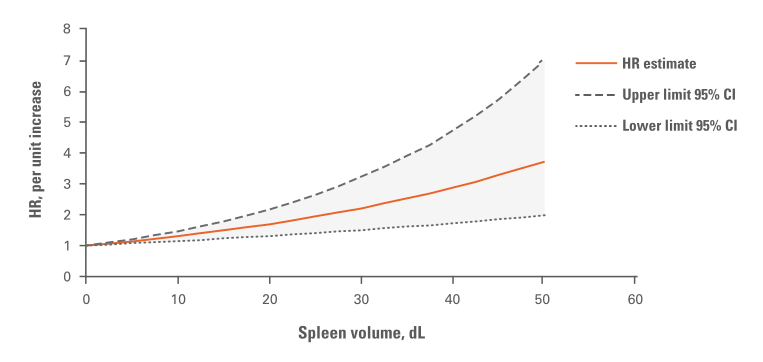
Larger baseline spleen volume was associated with incremental increases in the risk of death4
Relationship Between Spleen Volume and Risk of Death in the COMFORT Studies4
This material is under a CC BY-NC License and is the property of the Ferrata Storti Foundation. ©2025 Ferrata Storti Foundation. All rights reserved.
- In a post hoc pooled analysis of OS in the COMFORT studies (N=528), there was a 14% increase in the risk of death for each additional 5 dL in spleen volume at baseline over 3 years (HR, 1.14; 95% CI, 1.07-1.21)4‡
- These increases were seen irrespective of treatment4
†Progressive disease assignment for splenomegaly requires confirmation by CT or MRI showing a ≥25% increase in spleen volume from baseline. Baseline values for both physical examination and imaging studies refer to pretreatment baseline and not to posttreatment measurements.2
‡A post hoc pooled analysis of OS with ruxolitinib was performed using data from 2 phase 3 studies: COMFORT-I, a randomized, double-blind, placebo-controlled study with 309 patients with intermediate-2–risk or high-risk MF, and COMFORT-II, a randomized, open-label study with 219 patients with intermediate-2–risk or high-risk MF. The primary endpoint in both studies was the proportion of patients achieving a ≥35% reduction in spleen volume (measured by CT or MRI)—at week 24 in COMFORT-I and at week 48 in COMFORT-II.4,6,7
In the MPN Practice Perspectives Survey (N=1550),§

of HCPs allow the spleen to be >5 cm below the LCM before intervening


§1550 practicing hematologists/oncologists across the United States participated in the MPN Practice Perspectives Survey and provided comprehensive insights that could inform best practices to optimize the management of patients with MPN.
NCCN Clinical Practice Guidelines in Oncology (NCCN Guidelines®) recommend spleen assessment as part of the workup1

Palpating the spleen as part of the workup in patients with suspected MPNs1
Imaging, including ultrasound, may be appropriate for patients with a body habitus that precludes palpation.8
Palpation can be a quick and easy method for detecting and tracking splenomegaly9
- Assessing the spleen at diagnosis and routinely during follow-up allows longitudinal tracking of disease progression

Naveen Pemmaraju, MD, discusses splenomegaly as a marker of disease progression and shares his technique for spleen assessment

CI=confidence interval; COMFORT=COntrolled MyeloFibrosis study with ORal JAK inhibitor Treatment; CT=computed tomography; ELN=European LeukemiaNet; HR=hazard ratio; IWG-MRT=International Working Group-Myeloproliferative Neoplasms Research and Treatment; LCM=lower costal margin; MF=myelofibrosis; MPN=myeloproliferative neoplasm; MRI=magnetic resonance imaging; NCCN=National Comprehensive Cancer Network® (NCCN®); OS=overall survival.
References: 1. Referenced with permission from the NCCN Clinical Practice Guidelines in Oncology (NCCN Guidelines®) for Myeloproliferative Neoplasms V.1.2025. © National Comprehensive Cancer Network, Inc. 2025. All rights reserved. Accessed May 19, 2025. To view the most recent and complete version of the guideline, go online to NCCN.org. NCCN makes no warranties of any kind whatsoever regarding their content, use or application and disclaims any responsibility for their application or use in any way. 2. Tefferi A, Cervantes F, Mesa R, et al. Revised response criteria for myelofibrosis: International Working Group-Myeloproliferative Neoplasms Research and Treatment (IWG-MRT) and European LeukemiaNet (ELN) consensus report. Blood. 2013;122(8):1395-1398. 3. Barbui T, Barosi G, Birgegard G, et al. Philadelphia-negative classical myeloproliferative neoplasms: critical concepts and management recommendations from European LeukemiaNet. J Clin Oncol. 2011;29(6):761-770. 4. Vannucchi AM, Kantarjian HM, Kiladjian J-J, et al. A pooled analysis of overall survival in COMFORT-I and COMFORT-II, 2 randomized phase III trials of ruxolitinib for the treatment of myelofibrosis. Haematologica. 2015;100(9):1139-1145. Supplemental information available at: https://doi.org/10.3324/haematol.2014.119545. 5. Cervantes F, Dupriez B, Pereira A, et al. New prognostic scoring system for primary myelofibrosis based on a study of the International Working Group for Myelofibrosis Research and Treatment. Blood. 2009;113(13):2895-2901. 6. Verstovsek S, Mesa RA, Gotlib J, et al. A double-blind, placebo-controlled trial of ruxolitinib for myelofibrosis. N Engl J Med. 2012;366(9):799-807. Supplementary appendix available at: https://www.nejm.org/doi/full/10.1056/nejmoa1110557. 7. Harrison CN, Vannucchi AM, Kiladjian J-J, et al; on behalf of the COMFORT-II investigators. Long-term findings from COMFORT-II, a phase 3 study of ruxolitinib vs best available therapy for myelofibrosis. Leukemia. 2016;30(8):1701-1707. 8. Tremblay D, Schwartz M, Bakst R. Modern management of splenomegaly in patients with myelofibrosis. Ann Hematol. 2020;99(7):1441-1451. 9. Armitage JO. Spleen. In Walker HK, Hall WD, Hurst JW, eds. Clinical Methods: The History, Physical, and Laboratory Examinations. 3rd ed. Boston: Butterworths; 1990.